
Contribute to the conservation of sea turtles on Okinawa Island alongside professional local teams through an internship or a volunteer program with a positive and lasting impact!
You will have the opportunity to gain hands-on training while exploring the country, immersing yourself in its rich culture, and meeting inspiring people in an international setting.
This program is open to anyone motivated to learn and actively participate in the project.
This internship takes place in Japan, specifically on the island of Okinawa, in the south of the country.
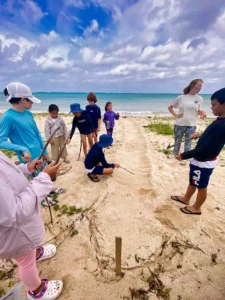
You will have the opportunity to take part in various missions depending on the time of year. From April to the end of July, as an intern, you will participate in night patrols on the beaches to monitor and support the nesting activity. In August and September, you will witness the hatching of baby turtles. Throughout the year, you will be involved in beach clean-ups, environmental education initiatives, fundraising events, data analysis, and various other activities, all aimed at contributing to sea turtle conservation.
The missions may vary throughout the year, but volunteers are generally expected to:
Observing nesting activity and assisting local professionals
Nest Protection
Rescue and Examination of Turtles
Data Collection
During these months, you will assist baby turtles and analyze nests. You will also carry out long-term missions throughout the year. Each period has its own unique tasks and learning opportunities, providing you with an enriching and unforgettable experience.
It is an organization specialized in arranging internships and volunteer missions in various fields and countries, including Japan. “Our mission is nothing less than ‘uniting the world.’ Our goal is to bring people from different cultures together so they can learn from each other, understand one another, and work together to improve living conditions on this planet.”
This program is available up to 24 weeks, contact us to know price and availabilities.
Arrival in Okinawa on Friday, program will start on Monday.
Housing is allocated by local NGOs, not by Freepackers - the descriptions are there to give you an idea of the type of accommodation, as it is very likely that conditions will vary on site depending on the number of volunteers, weather conditions, availability, etc. Each volunteer will be accommodated according to the stated conditions, but it is possible that the accommodation may not match the description or images shown on this site word for word, for example, in the case of annexed housing, renovations, relocations, etc.
You will be accommodated in a shared house in Yomitan, just a few minutes' walk from the sea turtle conservation office. The village of Yomitan has supermarkets and restaurants nearby.
Interns stay in dormitories of four people (two bunk beds per room), with gender-separated accommodations.
The accommodation includes a fully equipped kitchen, a spacious living room, a garden, and a large rooftop terrace. You will also have access to a washing machine and Wi-Fi connection.
Meals are not included in the program but the accommodation has a kitchen where volunteers can prepare their meals.
You can find all ressources on the World Organization Website, in the Travel Advice section A vaccine vial.
For all international projects, Realstep requires participants to take out travel insurance covering accidents, illness, and repatriation, as well as civil liability for professional activities abroad.
For complete protection while studying or interning abroad, you can take out Cap Student insurance online by following this link Student insurance abroad | Chapka Assurances, which will give you a 5% discount.
If you take out another insurance policy, we will ask you to send us a copy of your certificate in English.
Achieve the language level required for your international project with tailored support. The Clic-campus method Free Packers X Clic Campus foreign language training courses combines videoconference lessons and an innovative e-learning platform, offering complete flexibility from the comfort of your own home.
Here are the essential mandatory steps to complete:
Other steps may be necessary depending on the type of internship, the country, or other factors.
Our team will provide you with all the information you need.
Yes, many students have validated their internship through Real Step projects. Our placements meet schools’ academic requirements.
Les Français n’ont pas besoin de visa pour aller au Japon pour des séjours de moins de 3 mois, le passeport suffit. En revanche, un business visa ou un visa vacances travail (working holiday visa) sont indispensables pour rester plus de 3 mois, par exemple si vous prévoyez de travailler ou de faire un stage au Japon. Il faut alors faire la démarche à la section consulaire de l’Ambassade.
Il est de votre responsabilité de choisir le bon visa pour votre projet.
Les conditions de visa peuvent changer et le visa dépend de la nature de votre projet. Veuillez toujours vérifier sur France Diplomatie avant de réserver votre billet et de partir pour un programme et de vous y prendre en avance.
Traditionally, Japanese dress codes are formal: a dark suit, white shirt, and dark tie. However, foreign businesspeople can dress as they normally would in their home country. It is also often customary to remove your shoes (at home, in some restaurants, etc.).
The yen is Japan’s official currency.
The cost of living in Japan is 2.6% higher than in France.
When traveling, plan for an on-site budget of at least €80 per day per person (¥11,595 per day).
Most dietary requirements (kosher, vegetarian, halal, etc.) can be accommodated, provided you request it well in advance.
Our local partners in Tokyo arrange airport pick-up at the international airport every Friday. For students enrolled in internships outside the city, instructions for reaching the final destinations will be provided in advance or upon arrival.
Either in the main residence in Tokyo, at the internship location when it is remote (natural reserves, for example), or with a host family. This sea turtle conservation internship in Japan includes accommodation. Japan’s housing shortage has triggered an unprecedented surge in prices, so it is strongly recommended to have accommodation arranged in advance for at least the first month of your stay.
Working holiday and internship programs include free time every weekend so participants can explore the surrounding area. Project coordinators and local organizations are always happy to share advice on places to visit and the excursions available on weekends.
It depends on the program you choose. For those who want to stay for 1 year on a Working Holiday Visa on projects involving a paid job like this one, it is strongly recommended to take Japanese classes upon arrival (4 weeks of intensive courses) to broaden your job search options.
In fact, most jobs in retail, services, or the hospitality industry require an intermediate level of Japanese. For 3-month internships, these can be done in tourism organizations that only require English. Farm work does not require a high level of Japanese either.
To travel to Japan, spring—especially April/May—is the recommended period. Summer in Japan is the rainy season. June and July are particularly wet, and the heat starts to build. Temperatures range between 25°C and 30°C.
Currently, people who are allowed to travel to Japan are not required to be vaccinated. For real-time updates, we invite you to consult the Institut Pasteur website.
The local partner provides 24/7 assistance. Participants receive the coordinators’ contact details in advance, as well as an emergency number to call. The coordinators are available at all times, during the week and on weekends.
It depends on the company and the length of the internship. In Japan, working conditions are different, so it’s important to focus above all on learning and cultural immersion.

