
We would like to inform our community that we have decided to discontinue our collaboration with our marine projects in the Seychelles and Fiji.
This decision reflects a positive development: these projects have now reached full operational autonomy. They benefit from sufficient funding, a steady number of participants, and strong local capacities, allowing them to continue their conservation and research activities independently.
At Realstep, our mission is to focus our support where it can make the greatest and most immediate impact.
We therefore prioritize and promote independent marine projects facing more pressing needs and actively seeking committed volunteers, including:
Discover all our current marine conservation internships and scientific research programs through our dedicated project pages.
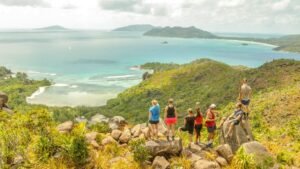
In the heart of the tropical paradise of Mahé Island, you will contribute to the collection of data and provide local authorities with important information on coral reefs, the movements of the whale shark population, or the reproduction of turtles.
A large part of this program is devoted to scuba diving expeditions. It is therefore essential to have at least the PADI open waters certificate (or equivalent). Novices who wish to participate in this project can pass the first level at the local dive center, it will be necessary to plan a departure one week before the start of the program.
If you ask yourself the question: “What to do during a gap year after a master 2”, we have a solution.
Volunteers work approximately 40-45 hours per week, with 2 days off per week, mostly weekends.
Like all of our Gap Year programs , in collaboration with the Ministry of the Environment, local NGOs and government agencies, you will participate in the following activities:
– 4 weeks before your arrival you will receive training in order to be operational upon your arrival.
– Monitoring and collecting data on coral reefs according to the seasons to study their state.
– Studying the different marine species in order to send them to OBIS Seamap which gathers information on marine species from all over the world.
– Depending on the season, observations on the migration of whale sharks, invertebrates, turtles, plankton, etc.
– Participate in the coral restoration project (collection, cleaning, transplanting to new sites, depending on the season).
– Train local partners on environmental research.
– Participate in seabed cleaning dives.
– Environmental awareness and education.
– These different subjects are studied at 24 sites on the northwest coast of Mahé.
Don’t forget that the progress of these projects depends on the season and the priorities defined by our local collaborators.
Diving equipment is not provided on-site, you will need to bring your own gear and rent the rest locally.
If you ask yourself the question: "What to do during a gap year after a master 2", we have a solution.
Volunteers work approximately 40-45 hours per week, with 2 days off per week, mostly weekends.
Like all of our Gap Year programs , in collaboration with the Ministry of the Environment, local NGOs and government agencies, you will participate in the following activities:
- 4 weeks before your arrival you will receive training in order to be operational upon your arrival.
- Monitoring and collecting data on coral reefs according to the seasons to study their state.
- Studying the different marine species in order to send them to OBIS Seamap which gathers information on marine species from all over the world.
- Depending on the season, observations on the migration of whale sharks, invertebrates, turtles, plankton, etc.
- Participate in the coral restoration project (collection, cleaning, transplanting to new sites, depending on the season).
- Train local partners on environmental research.
- Participate in seabed cleaning dives.
- Environmental awareness and education.
- These different subjects are studied at 24 sites on the northwest coast of Mahé.
Don't forget that the progress of these projects depends on the season and the priorities defined by our local collaborators.
Founded in 1997, our partner organisation coordinates projects around the world.
It employs 150 permanent staff in its local branches, which have already welcomed more than 20,000 volunteers in the field. It works closely with local organisations on long-term projects. They work only under the supervision of the community leaders and at their request.
– Creating sustainable solutions to support self-sustaining communities.
– Ensuring access to clean water sources.
– Developing micro-enterprises around food, with a particular focus on education and agriculture.
– Supporting local schools with school supplies.
– Providing expertise and ideas on energy and electricity issues.
– Implementation of studies and educational programs on the marine environment.
United Nations member organization
Our partner organisation sits on the United Nations International Commission on Sustainable Tourism. All their initiatives and volunteer projects are led by experts in collaboration with the local population and national governments.
As a non-profit organisation, our conservation project is completely transparent. The volunteer contribution is used to cover the planning of projects on the reserve (reconnaissance, team recruitment and logistical support), direct field costs (transportation, lodging, staff meals) and finally to support the project itself. Without the physical and financial help of the volunteers, this project would not have been possible.
It employs 150 permanent staff in its local branches, which have already welcomed more than 20,000 volunteers in the field. It works closely with local organisations on long-term projects. They work only under the supervision of the community leaders and at their request.
- Creating sustainable solutions to support self-sustaining communities.
- Ensuring access to clean water sources.
- Developing micro-enterprises around food, with a particular focus on education and agriculture.
- Supporting local schools with school supplies.
- Providing expertise and ideas on energy and electricity issues.
- Implementation of studies and educational programs on the marine environment.
United Nations member organization
Our partner organisation sits on the United Nations International Commission on Sustainable Tourism. All their initiatives and volunteer projects are led by experts in collaboration with the local population and national governments.
As a non-profit organisation, our conservation project is completely transparent. The volunteer contribution is used to cover the planning of projects on the reserve (reconnaissance, team recruitment and logistical support), direct field costs (transportation, lodging, staff meals) and finally to support the project itself. Without the physical and financial help of the volunteers, this project would not have been possible.
This program is available for up to 24 weeks, Please contact us for rates and availability.
| Duration | Fees to be paid upon registration |
|---|---|
| 2 Weeks | 2345€ |
| 4 Weeks | 3645€ |
| 6 Weeks | 4795€ |
| 8 Weeks | 5595€ |
| 10 Weeks | 6445€ |
| 12 Weeks | 7395€ |
Housing is allocated by local NGOs, not by Freepackers - the descriptions are there to give you an idea of the type of accommodation, as it is very likely that conditions will vary on site depending on the number of volunteers, weather conditions, availability, etc. Each volunteer will be accommodated according to the stated conditions, but it is possible that the accommodation may not match the description or images shown on this site word for word, for example, in the case of annexed housing, renovations, relocations, etc.
Volunteers will sleep in a mixed dormitory with a shared bathroom. There is cold running water for the shower and bottles of fresh drinking water will be made available to you. Volunteers will be expected to assist with tidying and cleaning tasks within the home.
All meals are provided by us and prepared by the participants. Breakfasts include eggs, bacon, toast, pancakes, cereal and fruit. Lunch and dinner vary according to the tastes of the participants at that time. Common meals include curries, stir fries, pastas, pies and salads. Many participants also buy their own snacks.
Communication
We are based in a protected nature reserve which means the signal does not cover the whole area. There are places where phone coverage is good and we have a phone on base for emergencies. For a high-speed connection, our participants go to the many Internet cafes in Victoria.
Diving courses available
Depending on the duration of the project, the following training will be provided to participants:
Training in the use of O2 and decompression equipment, first aid, PADI Advanced Open Water.
As an option, volunteers can obtain the following certifications during their stay:
- PADI Rescue Diver: 480 euros
- Emergency First Responder certification: 60 euros (only the diploma, the training is included in the price of volunteering).
Participants who wish to do so can pass their Open Waters level (necessary to participate in marine projects) before the start of their stay in the partner diving school. For more information and prices on their website: https://www.diveseychelles.com.sc/ .
On this site, you will also find the prices for the rental of diving equipment.
Please contact the embassy or immigration website of the country you wish to enter.
You can find all ressources on the World Organization Website, in the Travel Advice section A vaccine vial.
For all international projects, Realstep requires participants to take out travel insurance covering accidents, illness, and repatriation, as well as civil liability for professional activities abroad.
For complete protection while studying or interning abroad, you can take out Cap Student insurance online by following this link Student insurance abroad | Chapka Assurances, which will give you a 5% discount.
If you take out another insurance policy, we will ask you to send us a copy of your certificate in English.
Achieve the language level required for your international project with tailored support. The Clic-campus method Free Packers X Clic Campus foreign language training courses combines videoconference lessons and an innovative e-learning platform, offering complete flexibility from the comfort of your own home.
A gap year is a period (often 6 to 12 months) during which you temporarily pause your studies or work to have a meaningful, structured experience: travel, volunteering, internship, job, personal project…
It can be done at any time, for the duration you choose, and in the field you want. The goal is to help you explore new possibilities for your personal and/or professional path.
Real Step offers a wide range of gap year programs abroad in various fields.
Anyone! A gap year can be taken at any age and is not limited to 18–25-year-olds. It can be done at any stage of life—whether for a career change, a lifestyle change, to explore different options, or to refine a professional project.
A gap year allows you to:
It depends on the country and your project. Make sure to budget for:
Internships during a gap year are varied, and you have a wide choice of fields:
A wide range of internships is available, and our programs are suitable for many engineering fields, such as:
Feel free to contact us to learn about all our internship opportunities.
See our Ultimate Guide to Succeeding in Your Engineering Internship.

