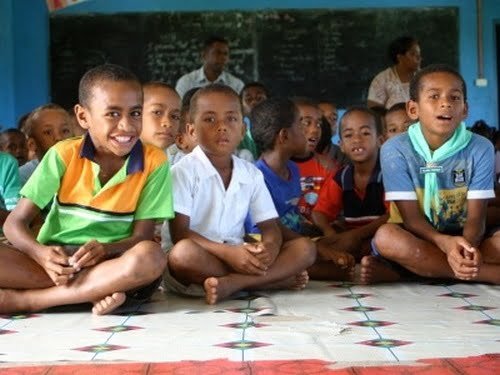
Fiji is waiting for you to help local teachers in local schools by participating in this training to work within an organization. Through tutoring workshops and educational games, benefit from a complete training, both theoretical and practical with in-depth support. While living a particularly rich professional experience, improve the skills of the teachers on site to thus increase the chances of success for the children of the archipelago.

The participants work in two primary schools in Dawasamu: that of Navuniesa, and that of Dawasamu district. They mainly participate in the improvement of the English language and the personal development of each with creative, artistic and sports workshops. Attending other lessons is also plausible during your training to work in an NGO.
This is a professionalizing experience in total immersion in Fijian culture. You work in collaboration with local communities, in order to best help children develop to counter the low quality education to which they have access. In practical terms, it is:
Like all of our training courses for working in humanitarian NGOs , this project in Fiji allows you to benefit from a complete learning experience, while having a positive and lasting impact on local communities.
This vocational training program is part of the so-called “career” projects. In addition to the mission that you carry out on site, it allows you to benefit from real support, and to access the position of project coordinator in 6 months. Here you combine theoretical training with practical learning, with online modules to be completed after the end of the mission. At the end of the program, you obtain an international certification recognized and issued by the University of Richmond, in the United States.
The accompaniment is therefore present upstream, on site but also downstream of the project. During the course of the mission, you will also have a remote project to carry out: you will have to solve a problem with other partner organizations in marine conservation, environment, animal protection… A coach will follow you and support you to help you in the best possible way in the resolution of these problems, and at the end of the project you will have access to a platform of job offers in NGOs, for which you will be eligible thanks to your professional training.
Remote projects included in professional training will be carried out AFTER having carried out the mission in the field.
If your training lasts 4-11 weeks, you will work on a remote project for a period of 4 weeks after completing the field assignment.
If your training lasts 12 weeks or more, you will work on 2 remote projects for a duration of 8 weeks after completing the field mission.
For more information on the employment guarantee conditions, click on the link:
Conditions on the job guarantee
Take a closer look at all the specificities of this training as a career program !
The results of the project since its inception:
The pupils of the primary schools in which the participants intervene were able to benefit from significant support. Teachers have also benefited from their help, through extensive support, particularly in the assessment of reading levels or by setting up individual and more personalized support courses. The contribution is also material, the schools have seen their resources for teaching grow. Participants also brought new teaching techniques to these schools, during their training to work in an NGO in the future.
The assignment depends on the skills and profile of the participants. A telephone interview and a registration file (CV and motivation letter) will determine the placement of the volunteers on educational projects ranging from childcare to the organisation of extracurricular activities and tutoring / assistance in schools for those with the most training.
Fiji is predominantly rural, with a minority of the population currently living in cities. The condition of women is not ideal either: in a typically patriarchal society, women are left out and still judged as inferior to men.
Women are thus not considered as breadwinners, their independence is particularly difficult to obtain. A third of the population in Fiji lives below the poverty line, making education for women even more important. Just one more year of primary school can dramatically increase a girl’s earnings, and an even greater increase with an extra year of high school.
In parliament, only 9% of seats go to women. There is a real need within the archipelago for the education of young girls in order to reduce these gender inequalities, to give everyone the same chance of succeeding in society, integrating the labor market and obtaining his independence. It is also through this fight that the poverty rate could decrease within the community.
The missions of the training in Fiji:
The last objective of this project is finally to allow you to benefit from training to work in an NGO thereafter.
This is a professionalizing experience in total immersion in Fijian culture. You work in collaboration with local communities, in order to best help children develop to counter the low quality education to which they have access. In practical terms, it is:
Like all of our training courses for working in humanitarian NGOs , this project in Fiji allows you to benefit from a complete learning experience, while having a positive and lasting impact on local communities.
This vocational training program is part of the so-called “career” projects. In addition to the mission that you carry out on site, it allows you to benefit from real support, and to access the position of project coordinator in 6 months. Here you combine theoretical training with practical learning, with online modules to be completed after the end of the mission. At the end of the program, you obtain an international certification recognized and issued by the University of Richmond, in the United States.
The accompaniment is therefore present upstream, on site but also downstream of the project. During the course of the mission, you will also have a remote project to carry out: you will have to solve a problem with other partner organizations in marine conservation, environment, animal protection... A coach will follow you and support you to help you in the best possible way in the resolution of these problems, and at the end of the project you will have access to a platform of job offers in NGOs, for which you will be eligible thanks to your professional training.
Remote projects included in professional training will be carried out AFTER having carried out the mission in the field.
If your training lasts 4-11 weeks, you will work on a remote project for a period of 4 weeks after completing the field assignment.
If your training lasts 12 weeks or more, you will work on 2 remote projects for a duration of 8 weeks after completing the field mission.
For more information on the employment guarantee conditions, click on the link:
Conditions on the job guarantee
Take a closer look at all the specificities of this training as a career program !
The results of the project since its inception:
The pupils of the primary schools in which the participants intervene were able to benefit from significant support. Teachers have also benefited from their help, through extensive support, particularly in the assessment of reading levels or by setting up individual and more personalized support courses. The contribution is also material, the schools have seen their resources for teaching grow. Participants also brought new teaching techniques to these schools, during their training to work in an NGO in the future.
The assignment depends on the skills and profile of the participants. A telephone interview and a registration file (CV and motivation letter) will determine the placement of the volunteers on educational projects ranging from childcare to the organisation of extracurricular activities and tutoring / assistance in schools for those with the most training.
Fiji is predominantly rural, with a minority of the population currently living in cities. The condition of women is not ideal either: in a typically patriarchal society, women are left out and still judged as inferior to men.
Women are thus not considered as breadwinners, their independence is particularly difficult to obtain. A third of the population in Fiji lives below the poverty line, making education for women even more important. Just one more year of primary school can dramatically increase a girl's earnings, and an even greater increase with an extra year of high school.
In parliament, only 9% of seats go to women. There is a real need within the archipelago for the education of young girls in order to reduce these gender inequalities, to give everyone the same chance of succeeding in society, integrating the labor market and obtaining his independence. It is also through this fight that the poverty rate could decrease within the community.
The missions of the training in Fiji:
The last objective of this project is finally to allow you to benefit from training to work in an NGO thereafter.
Founded in 1997, our partner organisation coordinates projects around the world. In Fiji, it works closely with local organizations on long-term projects.
– Creating sustainable solutions to support self-sustaining communities.
– Ensuring access to clean water sources.
– Developing micro-enterprises around food, with a particular focus on education and agriculture.
– Supporting local schools with school supplies.
– Providing expertise and ideas on energy and electricity issues.
– Implementation of studies and educational programs on the marine environment.
A large part of your contribution is used to cover your accommodation, airport pick-up, meals, etc. Another part consists of a donation to the project to invest in equipment, qualified personnel, etc. And the rest is allocated to the administrative cost of recruiting volunteers.
- Creating sustainable solutions to support self-sustaining communities.
- Ensuring access to clean water sources.
- Developing micro-enterprises around food, with a particular focus on education and agriculture.
- Supporting local schools with school supplies.
- Providing expertise and ideas on energy and electricity issues.
- Implementation of studies and educational programs on the marine environment.
A large part of your contribution is used to cover your accommodation, airport pick-up, meals, etc. Another part consists of a donation to the project to invest in equipment, qualified personnel, etc. And the rest is allocated to the administrative cost of recruiting volunteers.
This program is available for up to 24 weeks, Please contact us for rates and availability.
| Duration | Fees to be paid upon registration |
|---|---|
| 24 Weeks | 9395€ |
Housing is allocated by local NGOs, not by Freepackers - the descriptions are there to give you an idea of the type of accommodation, as it is very likely that conditions will vary on site depending on the number of volunteers, weather conditions, availability, etc. Each volunteer will be accommodated according to the stated conditions, but it is possible that the accommodation may not match the description or images shown on this site word for word, for example, in the case of annexed housing, renovations, relocations, etc.
You will be accommodated in dormitories with a shared kitchen and living space where you can relax with the other volunteers.
Meals will be taken at the volunteer house, 3 meals a day with vegetarian and vegan options.
The first 3 months, meals are included and the following 3 months, they are at the expense of the participants.
The meals are mainly vegetarian, made of local and seasonal products. Participants take turns preparing their own meals for the entire base.
Breakfast may consist of cereals, eggs and beans, fruit or pancakes, lunch may consist of rice dishes, vegetables, pasta and sauce, etc. And a typical dinner might include pasta, beans, rice and vegetables in a variety of sauces and flavors.
You will have limited access to long-distance communications during the program, so make sure your friends and family know how often they can expect to hear from you. Mobile phone reception is available at the base, although it can be poor at times. It is possible to purchase a Fijian SIM card and phone credit at the airport that can be used with your unlocked mobile phone. You can also buy a pocket WIFI device that can then be topped up with mobile internet.
Please contact the embassy or immigration website of the country you wish to enter.
You can find all ressources on the World Organization Website, in the Travel Advice section A vaccine vial.
For all international projects, Realstep requires participants to take out travel insurance covering accidents, illness, and repatriation, as well as civil liability for professional activities abroad.
For complete protection while studying or interning abroad, you can take out Cap Student insurance online by following this link Student insurance abroad | Chapka Assurances, which will give you a 5% discount.
If you take out another insurance policy, we will ask you to send us a copy of your certificate in English.
Achieve the language level required for your international project with tailored support. The Clic-campus method Free Packers X Clic Campus foreign language training courses combines videoconference lessons and an innovative e-learning platform, offering complete flexibility from the comfort of your own home. Translated with DeepL.com (free version)