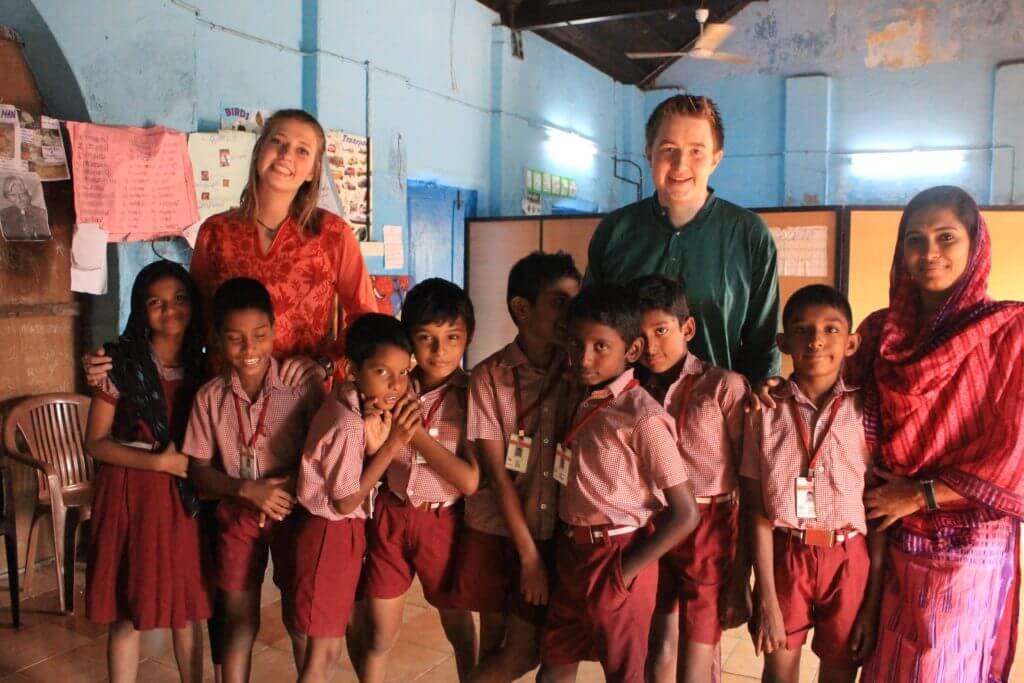
Join the team of specialist educators at the NGO and benefit from a truly professional experience, which will allow you to gain university credits. Participating in this project also means having a positive and lasting impact on the local community. You will be working at the Fort Kochi Home for Disabled Children, contributing to their education.


Are you looking for an internship in an NGO in India? If you have experience in the medical field or experience with children with learning disabilities, we are looking for interns in centers for the disabled such as hospitals, nursing homes, schools, etc. You will be able to help with education and leisure activities as well as psychomotor activities while doing this internship in India. Like all of our humanitarian internship programs, the project in India allows you to gain university credits while making a positive and lasting impact on the local community.
When accompanying children with disabilities in a drop-in center, your tasks will include assisting local teachers and educators with their classes, providing educational ideas and tools. The school welcomes more than 100 children, suffering from various mental illnesses: dyslexia, autism, down syndrome, deaf and dumb children).
A typical volunteer’s day begins with breakfast at 8:30 a.m., and workdays run from 9 a.m. to 3 p.m., Monday to Friday. A coordinator is always present to facilitate exchanges in all our programs. Lunch is taken at home or at the workplace.
In the afternoon or evening, volunteers can take classes, participate in workshops, visit the city and have dinner.
The assignment depends on the skills and profile of the participants. A telephone interview and an application (CV and cover letter) will determine the placement of the volunteers on educational projects ranging from childcare to the organisation of extracurricular activities and tutoring / assistance in schools for those with the most training.
Yoga classes, cooking classes, painting classes, pottery classes, meditation classes, Hindi language classes, Ayurveda classes and Ayurvedic massages, temple visits, excursions, surfing, cycling, trekking, and many other adventures during this course in India!
So if you are looking for an internship in an NGO in India, get involved in this special educator project!
When accompanying children with disabilities in a drop-in center, your tasks will include assisting local teachers and educators with their classes, providing educational ideas and tools. The school welcomes more than 100 children, suffering from various mental illnesses: dyslexia, autism, down syndrome, deaf and dumb children).
A typical volunteer's day begins with breakfast at 8:30 a.m., and workdays run from 9 a.m. to 3 p.m., Monday to Friday. A coordinator is always present to facilitate exchanges in all our programs. Lunch is taken at home or at the workplace.
In the afternoon or evening, volunteers can take classes, participate in workshops, visit the city and have dinner.
The assignment depends on the skills and profile of the participants. A telephone interview and an application (CV and cover letter) will determine the placement of the volunteers on educational projects ranging from childcare to the organisation of extracurricular activities and tutoring / assistance in schools for those with the most training.
Yoga classes, cooking classes, painting classes, pottery classes, meditation classes, Hindi language classes, Ayurveda classes and Ayurvedic massages, temple visits, excursions, surfing, cycling, trekking, and many other adventures during this course in India!
So if you are looking for an internship in an NGO in India, get involved in this special educator project!
Our local NGO prioritises the safety and well-being of its volunteers to ensure that they have the best possible experience with the children and local communities, and that they have lasting memories of their mission. The costs charged by the association allow for the financing of operating services, on-site staff, volunteer expenses (meals, lodging, transportation, activities) and a portion of the funds paid to the projects themselves.
Our local NGO prioritises the safety and well-being of its volunteers to ensure that they have the best possible experience with the children and local communities, and that they have lasting memories of their mission. The costs charged by the association allow for the financing of operating services, on-site staff, volunteer expenses (meals, lodging, transportation, activities) and a portion of the funds paid to the projects themselves.
This program is available for up to 24 weeks, Please contact us for rates and availability.
| Duration | Fees to be paid upon registration |
|---|---|
| 4 Weeks | 1555€ |
| 8 Weeks | 2235€ |
| 12 Weeks | 3115€ |
| 16 Weeks | 3430€ |
Housing is allocated by local NGOs, not by Freepackers - the descriptions are there to give you an idea of the type of accommodation, as it is very likely that conditions will vary on site depending on the number of volunteers, weather conditions, availability, etc. Each volunteer will be accommodated according to the stated conditions, but it is possible that the accommodation may not match the description or images shown on this site word for word, for example, in the case of annexed housing, renovations, relocations, etc.
Volunteers stay in a shared house with other volunteers, with rooms consisting of 4 volunteers. The windows are equipped with mosquito nets. The house has European style toilets, cold water showers and wifi in the common areas. Coffee, tea and fresh water are available all day and the kitchen also has a fridge for volunteers. A large balcony and rooftop are also available to students and volunteers. The office of the NGO is located downstairs and is available from 8am to 5pm every day.
Private rooms are available at an additional cost of $25/night.
Three meals are provided per day, with the exception of Sunday night dinner.
South Indian food is tasty and varied, and volunteers can expect to experience a variety of local flavours and meals during their experience.
Breakfast is different every day and will be either an Indian breakfast or on some days eggs, bread, fruit, tea and coffee. Lunch and dinner are local curry dishes made with coconut, rice, roti or chapatti.
Meals are generally vegetarian and include potatoes, okra, aubergine, squash, carrots, beets and various pulses and lentils. If you have food needs, please inform us in advance so that the NGO can make the necessary arrangements on site.
If you want to eat western food, you can easily get it at the cafes and restaurants in the area.
If you would like to contribute to the project, you can bring the following items:
Reading books, English learning activity books, toys, art materials, stickers, puppets, educational games, used electronic equipment. English and grammar books are always popular.
We also ask that you bring your laptops or ipads, as you can use them to plan your lessons.
Please contact the embassy or immigration website of the country you wish to enter.
You can find all ressources on the World Organization Website, in the Travel Advice section A vaccine vial.
For all international projects, Realstep requires participants to take out travel insurance covering accidents, illness, and repatriation, as well as civil liability for professional activities abroad.
For complete protection while studying or interning abroad, you can take out Cap Student insurance online by following this link Student insurance abroad | Chapka Assurances, which will give you a 5% discount.
If you take out another insurance policy, we will ask you to send us a copy of your certificate in English.
Achieve the language level required for your international project with tailored support. The Clic-campus method Free Packers X Clic Campus foreign language training courses combines videoconference lessons and an innovative e-learning platform, offering complete flexibility from the comfort of your own home.
A gap year is a period (often 6 to 12 months) during which you temporarily pause your studies or work to have a meaningful, structured experience: travel, volunteering, internship, job, personal project…
It can be done at any time, for the duration you choose, and in the field you want. The goal is to help you explore new possibilities for your personal and/or professional path.
Real Step offers a wide range of gap year programs abroad in various fields.
Anyone! A gap year can be taken at any age and is not limited to 18–25-year-olds. It can be done at any stage of life—whether for a career change, a lifestyle change, to explore different options, or to refine a professional project.
A gap year allows you to:
It depends on the country and your project. Make sure to budget for:
Internships during a gap year are varied, and you have a wide choice of fields:
Interns are accommodated in shared houses, hostels, or sometimes with local host families. You will have access to all essential amenities and are often close to shops so you can easily find what you need.
Departure dates are flexible; it is possible to leave every week. Please contact us to find out about program availability.
This depends on the missions. Local coordinators are on site to facilitate communication, but a minimum B1 level is often recommended to communicate locally. Some technical or research placements may require a higher level.
You can take language classes before you leave for your project.
The participation requirements are listed on each program page.
Yes, you will have a local coordinator on site as your main point of contact to answer your questions, ensure your safety, and support you if needed. You will always have an orientation upon arrival, including: an introduction to the project, the local team, your missions, and the rules to follow. The team also explains safety guidelines (recommended behavior, areas to avoid).
Local emergency assistance is available 24/7. We remain reachable throughout the entire project.
In addition, the projects we offer are carefully selected with reliable partners and in suitable destinations.
Internship schedules may vary depending on your program. In general, you will work between 30 and 40 hours per week. We specify these conditions on the program pages or in the downloadable brochures.
Yes, absolutely! Real Step internships are open to solo travelers, pairs, or groups. Many schools and students even organize group departures through our programs.
There are many diverse destinations: Asia, Europe, Africa, and Latin America—all around the world!
By joining a project with us, you are supported at every step.
You can contact us to explain your situation. If you have valid reasons to request a new placement, we will send you a request form. You will be informed as soon as a spot becomes available. You will then be able to change location, subject to availability.
There are different ways to finance part of your project. We have several resources to help you find funding support, whether through student mobility scholarships, Erasmus+ funding for projects in Europe, or regional grants. Some volunteers have also organized group fundraising initiatives.
For young people aged 18 to 30, it is possible to go abroad with a Working Holiday Visa (WHV) and work on site to finance part of the project.
Even without financial aid, a well-prepared project can be made accessible through a mix of “savings + fundraising + a job on site”.
Find all the information on funding your internship in this article.
The price covers accommodation, supervision, part of the local organization (meals, orientation), Freepackers’ expertise, and support for the projects. Part of the project fee is used to help develop the project on site. Our teams visit the projects to ensure they are safe, useful, and reliable.
Yes, you will have free time and you can go out, visit places, and travel, especially on weekends. You just need to respect the program’s organization (schedule, mission days) and follow the safety guidelines given by the local team. In some destinations, the team can also recommend places to explore.
Here are the essential mandatory steps to complete:
Other steps may be necessary depending on the type of internship, the country, or other factors.
Our team will provide you with all the information you need.
No, most of the internships we offer are unpaid, but this can vary depending on the host organization, the duration, and the country.
Yes, many students have validated their internship through Real Step projects. Our placements meet schools’ academic requirements.
A wide range of internships is available, and our programs are suitable for many engineering fields, such as:
Feel free to contact us to learn about all our internship opportunities.
See our Ultimate Guide to Succeeding in Your Engineering Internship.
This can vary depending on your school and your year of study, but in general you can go for 4 to 16 weeks.
Three months is often the duration required by schools to help you develop skills. To learn more about 3-month engineering internships.
Your missions can vary greatly depending on your specialty and your level of study and commitment, but overall you will be asked to take part in:
The goal is to encourage the practical application of the knowledge you have gained during your studies—skills you will be able to highlight later on.
Find our detailed advice in our guide Engineering internship cover letter: land an international experience.
Yes, many students have validated their internship through Real Step projects. Our placements meet schools’ academic requirements.
We offer many internships in a wide range of areas, such as:
Even though some details vary depending on the country, here are the main steps:
To understand the exact process, we recommend reading this article in detail.
You can go on a WHV to the following destinations:
Check our website to make sure you don’t miss a program—or contact us!
The budget needed for a WHV depends on the country you choose, your lifestyle, and the length of your stay.
Expenses to plan for:
Yes. You can take English or Spanish courses before you leave, or even during your project.
Course schedules are flexible depending on your goal. You can choose to take a few hours per week, or fully focus on your language courses over a longer period to prepare for a project such as a WHV or a job abroad.
Les Français n’ont pas besoin de visa pour aller au Japon pour des séjours de moins de 3 mois, le passeport suffit. En revanche, un business visa ou un visa vacances travail (working holiday visa) sont indispensables pour rester plus de 3 mois, par exemple si vous prévoyez de travailler ou de faire un stage au Japon. Il faut alors faire la démarche à la section consulaire de l’Ambassade.
Il est de votre responsabilité de choisir le bon visa pour votre projet.
Les conditions de visa peuvent changer et le visa dépend de la nature de votre projet. Veuillez toujours vérifier sur France Diplomatie avant de réserver votre billet et de partir pour un programme et de vous y prendre en avance.
Traditionally, Japanese dress codes are formal: a dark suit, white shirt, and dark tie. However, foreign businesspeople can dress as they normally would in their home country. It is also often customary to remove your shoes (at home, in some restaurants, etc.).
The yen is Japan’s official currency.
The cost of living in Japan is 2.6% higher than in France.
When traveling, plan for an on-site budget of at least €80 per day per person (¥11,595 per day).
Most dietary requirements (kosher, vegetarian, halal, etc.) can be accommodated, provided you request it well in advance.
Our local partners in Tokyo arrange airport pick-up at the international airport every Friday. For students enrolled in internships outside the city, instructions for reaching the final destinations will be provided in advance or upon arrival.
Either in the main residence in Tokyo, at the internship location when it is remote (natural reserves, for example), or with a host family. This sea turtle conservation internship in Japan includes accommodation. Japan’s housing shortage has triggered an unprecedented surge in prices, so it is strongly recommended to have accommodation arranged in advance for at least the first month of your stay.
Working holiday and internship programs include free time every weekend so participants can explore the surrounding area. Project coordinators and local organizations are always happy to share advice on places to visit and the excursions available on weekends.
It depends on the program you choose. For those who want to stay for 1 year on a Working Holiday Visa on projects involving a paid job like this one, it is strongly recommended to take Japanese classes upon arrival (4 weeks of intensive courses) to broaden your job search options.
In fact, most jobs in retail, services, or the hospitality industry require an intermediate level of Japanese. For 3-month internships, these can be done in tourism organizations that only require English. Farm work does not require a high level of Japanese either.
To travel to Japan, spring—especially April/May—is the recommended period. Summer in Japan is the rainy season. June and July are particularly wet, and the heat starts to build. Temperatures range between 25°C and 30°C.
Currently, people who are allowed to travel to Japan are not required to be vaccinated. For real-time updates, we invite you to consult the Institut Pasteur website.
The local partner provides 24/7 assistance. Participants receive the coordinators’ contact details in advance, as well as an emergency number to call. The coordinators are available at all times, during the week and on weekends.
Look into official channels to find opportunities. It is also important to adapt your application to the country’s norms (the CV and cover letter are different).
Finally, Real Step offers internships in Japan in various fields that may interest you! In ecology or even IT, communication, marketing, etc.
It depends on the company and the length of the internship. In Japan, working conditions are different, so it’s important to focus above all on learning and cultural immersion.