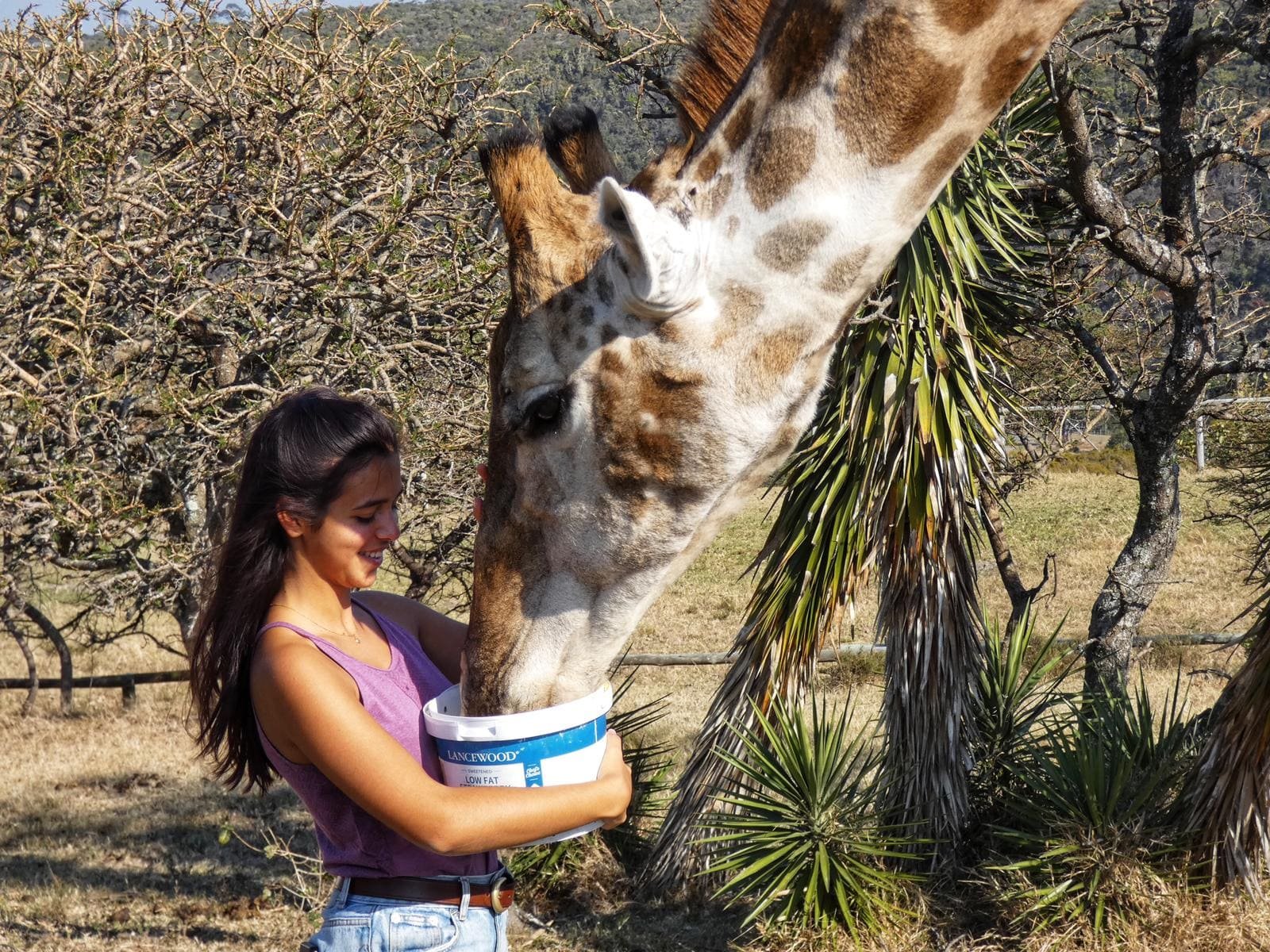
Immerse yourself in the local culture and complete your veterinary internship in South Africa with our partner NGO. Supervised by experts, you will benefit from in-depth feedback throughout the project, allowing you to experience life in the international professional world. Join a multicultural team and work on a reserve to contribute to the protection of the region’s wildlife on a daily basis.


The veterinary internship in South Africa will take place in the following African reserves:
– Mpongo, a famous reserve with the Big 5 (lions, elephants, rhinos, buffalos and leopards).
– Sabati is an area suitable for conservation and is being developed with a recent introduction of wildlife.
– Matola is a nature reserve located in the Kubusi Valley. The NGO has also recently started a conservation project in this reserve with a combination of activities related to safaris.
Like all of our animal internship programs abroad, this project in South Africa allows students to gain university credits while contributing to the conservation of the region’s wildlife.
1. Monitoring and observation of wildlife in the reserve.
2. Surgical care of livestock in local farms.
3. Caring for domestic animals in the surrounding villages.
There are many pets that lack care, animal rights are far from being a priority on the social agenda of South Africa. The work is therefore particularly demanding, but this placement with specialists is intended to provide you with the best possible experience in all three areas of activity.
Participants of the veterinary internship in South Africa will spend approximately one third of their time in the wild (game reserves). Theoretical and practical learning will include the following:
– Health and safety.
– Immobilisation and sedation of animals.
– Capture and transfer of animals (normally at least once during the course, but this will depend on the season and ongoing activities).
– Management of animals in the reserve.
– Protection of ecosystems and biodiversity.
– Threats to wildlife.
– Poisonous and venomous animals.
– Animal health and nutrition.
Project participants will visit several livestock farms to gain a variety of hands-on experience, and will actively participate in the care of the animals. Topics covered in class and in the field are:
– Health and safety.
– Animal health and behaviour.
– Immobilisation, sedation and injections.
– Animal management.
– Protection of biodiverse ecosystems.
– Animal health and nutrition.
You will also have the opportunity to gain hands-on experience in pet care through visits to rural villages. In South Africa, domestic animals are often vulnerable and mistreated, living in very difficult conditions. We are therefore making this a priority. As a volunteer or intern, this is also the area where you can get most involved. The training (theoretical and practical) covers the following elements:
– Health and safety.
– Community education and understanding of domestic animal management in the South African context.
– Animal health and behaviour.
– Immobilisation, sedation and injections.
– Animal health and nutrition.
You will also have the opportunity to work in collaboration with national animal welfare agencies, such as the SPCA (South African Society for the Prevention of Cruelty to Animals), whose activities you will discover in the field.
You will participate in a demanding animal management program. Of course, you will have some great moments releasing healthy animals into the wild or tracking buffalos and elephants. But some days can also be exhausting, especially when you will be in charge of securing hiking trails or looking for traps set by poachers. You will have a busy time working in the field, but you will also be expected to assist the caretakers in their daily and routine maintenance tasks.
In any case, all the tasks you will be given are of great importance to this conservation and environmental project. This veterinary training course in South Africa is anything but a safari, there is no question of going there to relax or to do tourism!
Like all of our animal internship programs abroad, this project in South Africa allows students to gain university credits while contributing to the conservation of the region's wildlife.
1. Monitoring and observation of wildlife in the reserve.
2. Surgical care of livestock in local farms.
3. Caring for domestic animals in the surrounding villages.
There are many pets that lack care, animal rights are far from being a priority on the social agenda of South Africa. The work is therefore particularly demanding, but this placement with specialists is intended to provide you with the best possible experience in all three areas of activity.
Participants of the veterinary internship in South Africa will spend approximately one third of their time in the wild (game reserves). Theoretical and practical learning will include the following:
- Health and safety.
- Immobilisation and sedation of animals.
- Capture and transfer of animals (normally at least once during the course, but this will depend on the season and ongoing activities).
- Management of animals in the reserve.
- Protection of ecosystems and biodiversity.
- Threats to wildlife.
- Poisonous and venomous animals.
- Animal health and nutrition.
Project participants will visit several livestock farms to gain a variety of hands-on experience, and will actively participate in the care of the animals. Topics covered in class and in the field are:
- Health and safety.
- Animal health and behaviour.
- Immobilisation, sedation and injections.
- Animal management.
- Protection of biodiverse ecosystems.
- Animal health and nutrition.
You will also have the opportunity to gain hands-on experience in pet care through visits to rural villages. In South Africa, domestic animals are often vulnerable and mistreated, living in very difficult conditions. We are therefore making this a priority. As a volunteer or intern, this is also the area where you can get most involved. The training (theoretical and practical) covers the following elements:
- Health and safety.
- Community education and understanding of domestic animal management in the South African context.
- Animal health and behaviour.
- Immobilisation, sedation and injections.
- Animal health and nutrition.
You will also have the opportunity to work in collaboration with national animal welfare agencies, such as the SPCA (South African Society for the Prevention of Cruelty to Animals), whose activities you will discover in the field.
You will participate in a demanding animal management program. Of course, you will have some great moments releasing healthy animals into the wild or tracking buffalos and elephants. But some days can also be exhausting, especially when you will be in charge of securing hiking trails or looking for traps set by poachers. You will have a busy time working in the field, but you will also be expected to assist the caretakers in their daily and routine maintenance tasks.
In any case, all the tasks you will be given are of great importance to this conservation and environmental project. This veterinary training course in South Africa is anything but a safari, there is no question of going there to relax or to do tourism!
Our partner NGO manages and implements volunteer and humanitarian projects throughout South Africa: social missions, educational missions and environmental protection.
Founded in 2004, the Association has since placed thousands of volunteers on long-term projects that do not aim to save lives but to improve the daily lives of the most disadvantaged.
Awarded several times for its commitment to sustainable development volunteer projects in South Africa, our NGO is also accredited by the international Fair Trade Tourism label.
Founded in 2004, the Association has since placed thousands of volunteers on long-term projects that do not aim to save lives but to improve the daily lives of the most disadvantaged.
Awarded several times for its commitment to sustainable development volunteer projects in South Africa, our NGO is also accredited by the international Fair Trade Tourism label.
This program is available for up to 24 weeks, Please contact us for rates and availability.
| Duration | Fees to be paid upon registration |
|---|---|
| 4 Weeks | 3903€ |
| 6 Weeks | 5623€ |
| 8 Weeks | 7295€ |
Housing is allocated by local NGOs, not by Freepackers - the descriptions are there to give you an idea of the type of accommodation, as it is very likely that conditions will vary on site depending on the number of volunteers, weather conditions, availability, etc. Each volunteer will be accommodated according to the stated conditions, but it is possible that the accommodation may not match the description or images shown on this site word for word, for example, in the case of annexed housing, renovations, relocations, etc.
The volunteer house is located in the coastal town of Chintsa, a few minutes walk from the beach. Volunteers and interns are housed in shared rooms with a common kitchen and living areas.
A washing machine is available for volunteers, as well as a wifi connection, but we recommend purchasing a SIM card upon arrival, as the connection is intermittent in the house.
Depending on the nature of the experience, volunteers will work between different reserves, farms and rural villages and will be mobilised where the work is. The program's housing responds to this need, so you can expect to stay in a wide variety of accommodations in the greater Chintsa area.
These will always be comfortable and safe places and may include tented camps near the work site, bush cabins, farm houses, and sometimes lodges.
Optional activities
- Cultural visits.
- Safaris in natural reserves.
- Excursions on quad bikes or mountain bikes.
- Additional activities from Cape Town
- Additional activities from Johannesburg
Winter in South Africa
Please note that from May to September it is winter in South Africa and it can be quite cold with an average temperature ranging from 5 to 15º. Make sure you bring enough warm clothes if you plan your trip during this period.
Please contact the embassy or immigration website of the country you wish to enter.
You can find all ressources on the World Organization Website, in the Travel Advice section A vaccine vial.
For all international projects, Realstep requires participants to take out travel insurance covering accidents, illness, and repatriation, as well as civil liability for professional activities abroad.
For complete protection while studying or interning abroad, you can take out Cap Student insurance online by following this link Student insurance abroad | Chapka Assurances, which will give you a 5% discount.
If you take out another insurance policy, we will ask you to send us a copy of your certificate in English.
Achieve the language level required for your international project with tailored support. The Clic-campus method Free Packers X Clic Campus foreign language training courses combines videoconference lessons and an innovative e-learning platform, offering complete flexibility from the comfort of your own home.
A gap year is a period (often 6 to 12 months) during which you temporarily pause your studies or work to have a meaningful, structured experience: travel, volunteering, internship, job, personal project…
It can be done at any time, for the duration you choose, and in the field you want. The goal is to help you explore new possibilities for your personal and/or professional path.
Real Step offers a wide range of gap year programs abroad in various fields.
Anyone! A gap year can be taken at any age and is not limited to 18–25-year-olds. It can be done at any stage of life—whether for a career change, a lifestyle change, to explore different options, or to refine a professional project.
A gap year allows you to:
It depends on the country and your project. Make sure to budget for:
Internships during a gap year are varied, and you have a wide choice of fields:
Interns are accommodated in shared houses, hostels, or sometimes with local host families. You will have access to all essential amenities and are often close to shops so you can easily find what you need.
Departure dates are flexible; it is possible to leave every week. Please contact us to find out about program availability.
This depends on the missions. Local coordinators are on site to facilitate communication, but a minimum B1 level is often recommended to communicate locally. Some technical or research placements may require a higher level.
You can take language classes before you leave for your project.
The participation requirements are listed on each program page.
Yes, you will have a local coordinator on site as your main point of contact to answer your questions, ensure your safety, and support you if needed. You will always have an orientation upon arrival, including: an introduction to the project, the local team, your missions, and the rules to follow. The team also explains safety guidelines (recommended behavior, areas to avoid).
Local emergency assistance is available 24/7. We remain reachable throughout the entire project.
In addition, the projects we offer are carefully selected with reliable partners and in suitable destinations.
Internship schedules may vary depending on your program. In general, you will work between 30 and 40 hours per week. We specify these conditions on the program pages or in the downloadable brochures.
Yes, absolutely! Real Step internships are open to solo travelers, pairs, or groups. Many schools and students even organize group departures through our programs.
There are many diverse destinations: Asia, Europe, Africa, and Latin America—all around the world!
By joining a project with us, you are supported at every step.
You can contact us to explain your situation. If you have valid reasons to request a new placement, we will send you a request form. You will be informed as soon as a spot becomes available. You will then be able to change location, subject to availability.
There are different ways to finance part of your project. We have several resources to help you find funding support, whether through student mobility scholarships, Erasmus+ funding for projects in Europe, or regional grants. Some volunteers have also organized group fundraising initiatives.
For young people aged 18 to 30, it is possible to go abroad with a Working Holiday Visa (WHV) and work on site to finance part of the project.
Even without financial aid, a well-prepared project can be made accessible through a mix of “savings + fundraising + a job on site”.
Find all the information on funding your internship in this article.
The price covers accommodation, supervision, part of the local organization (meals, orientation), Freepackers’ expertise, and support for the projects. Part of the project fee is used to help develop the project on site. Our teams visit the projects to ensure they are safe, useful, and reliable.
Yes, you will have free time and you can go out, visit places, and travel, especially on weekends. You just need to respect the program’s organization (schedule, mission days) and follow the safety guidelines given by the local team. In some destinations, the team can also recommend places to explore.
Here are the essential mandatory steps to complete:
Other steps may be necessary depending on the type of internship, the country, or other factors.
Our team will provide you with all the information you need.
No, most of the internships we offer are unpaid, but this can vary depending on the host organization, the duration, and the country.
Yes, many students have validated their internship through Real Step projects. Our placements meet schools’ academic requirements.
A wide range of internships is available, and our programs are suitable for many engineering fields, such as:
Feel free to contact us to learn about all our internship opportunities.
See our Ultimate Guide to Succeeding in Your Engineering Internship.
This can vary depending on your school and your year of study, but in general you can go for 4 to 16 weeks.
Three months is often the duration required by schools to help you develop skills. To learn more about 3-month engineering internships.
Your missions can vary greatly depending on your specialty and your level of study and commitment, but overall you will be asked to take part in:
The goal is to encourage the practical application of the knowledge you have gained during your studies—skills you will be able to highlight later on.
Find our detailed advice in our guide Engineering internship cover letter: land an international experience.
Yes, many students have validated their internship through Real Step projects. Our placements meet schools’ academic requirements.
We offer many internships in a wide range of areas, such as:
Even though some details vary depending on the country, here are the main steps:
To understand the exact process, we recommend reading this article in detail.
You can go on a WHV to the following destinations:
Check our website to make sure you don’t miss a program—or contact us!
The budget needed for a WHV depends on the country you choose, your lifestyle, and the length of your stay.
Expenses to plan for:
Yes. You can take English or Spanish courses before you leave, or even during your project.
Course schedules are flexible depending on your goal. You can choose to take a few hours per week, or fully focus on your language courses over a longer period to prepare for a project such as a WHV or a job abroad.
Les Français n’ont pas besoin de visa pour aller au Japon pour des séjours de moins de 3 mois, le passeport suffit. En revanche, un business visa ou un visa vacances travail (working holiday visa) sont indispensables pour rester plus de 3 mois, par exemple si vous prévoyez de travailler ou de faire un stage au Japon. Il faut alors faire la démarche à la section consulaire de l’Ambassade.
Il est de votre responsabilité de choisir le bon visa pour votre projet.
Les conditions de visa peuvent changer et le visa dépend de la nature de votre projet. Veuillez toujours vérifier sur France Diplomatie avant de réserver votre billet et de partir pour un programme et de vous y prendre en avance.
Traditionally, Japanese dress codes are formal: a dark suit, white shirt, and dark tie. However, foreign businesspeople can dress as they normally would in their home country. It is also often customary to remove your shoes (at home, in some restaurants, etc.).
The yen is Japan’s official currency.
The cost of living in Japan is 2.6% higher than in France.
When traveling, plan for an on-site budget of at least €80 per day per person (¥11,595 per day).
Most dietary requirements (kosher, vegetarian, halal, etc.) can be accommodated, provided you request it well in advance.
Our local partners in Tokyo arrange airport pick-up at the international airport every Friday. For students enrolled in internships outside the city, instructions for reaching the final destinations will be provided in advance or upon arrival.
Either in the main residence in Tokyo, at the internship location when it is remote (natural reserves, for example), or with a host family. This sea turtle conservation internship in Japan includes accommodation. Japan’s housing shortage has triggered an unprecedented surge in prices, so it is strongly recommended to have accommodation arranged in advance for at least the first month of your stay.
Working holiday and internship programs include free time every weekend so participants can explore the surrounding area. Project coordinators and local organizations are always happy to share advice on places to visit and the excursions available on weekends.
It depends on the program you choose. For those who want to stay for 1 year on a Working Holiday Visa on projects involving a paid job like this one, it is strongly recommended to take Japanese classes upon arrival (4 weeks of intensive courses) to broaden your job search options.
In fact, most jobs in retail, services, or the hospitality industry require an intermediate level of Japanese. For 3-month internships, these can be done in tourism organizations that only require English. Farm work does not require a high level of Japanese either.
To travel to Japan, spring—especially April/May—is the recommended period. Summer in Japan is the rainy season. June and July are particularly wet, and the heat starts to build. Temperatures range between 25°C and 30°C.
Currently, people who are allowed to travel to Japan are not required to be vaccinated. For real-time updates, we invite you to consult the Institut Pasteur website.
The local partner provides 24/7 assistance. Participants receive the coordinators’ contact details in advance, as well as an emergency number to call. The coordinators are available at all times, during the week and on weekends.
Look into official channels to find opportunities. It is also important to adapt your application to the country’s norms (the CV and cover letter are different).
Finally, Real Step offers internships in Japan in various fields that may interest you! In ecology or even IT, communication, marketing, etc.
It depends on the company and the length of the internship. In Japan, working conditions are different, so it’s important to focus above all on learning and cultural immersion.